The year 2026 is already signaling a wide range of vibrant experiences for India, no matter if you are a frequent traveler or just planning your first big adventure. The country has started to let go of the conventional India Key Attractions for 2026 tourist attractions and is now offering to denude one's soul and heart through significant deeply personal trips from the foggy "Inner Belt" of the Himalayas to the brightly colored beaches of the south.If you're asking yourself which place will have the most vibrant sound coming from the "Heart of the Earth" for the next year, this guide will reveal the must-have trendy places to visit, off the beaten path spots, and spiritual trails that are fetching the highest search volume for the year 2026.
What are the Top Trending Destinations in India for 2026?
The year 2026 looks promising in terms of changing travel trends. The holidaymakers are retreating from the packed hotels and are searching for experiences like "Altitude Shifts" and "Glowmad" (beauty and wellness-centered) ones, to name a few.
- Jorhat, Assam: The city at the top of the list with almost a five-fold increase in demand, Jorhat is the point of access to Majuli—the largest river island in the world—and provides a quiet "reset" amongst the infinite tea estates.
- Varanasi, Uttar Pradesh: It is not only the place for religious people anymore. Varanasi is becoming a place to visit for families and Gen Z as they are fascinated by the Ganga Aarti, the silk weaving clusters, and the city's ancient, raw energy.
- Kashmir & Ladakh: The improvement of the infrastructure and the rise of eco-luxury camps make the "Paradise on Earth" and the "Land of High Passes" to be the ultimate travel destinations for the year 2026
Is India Issuing an e-Visa?
In 2026, India will be issuing e-Visas to eligible international travelers. The e-Visa system continues to work in favor of the entry into India in a simpler and more comfortable way by providing the option for the travelers to complete the process digitally before their arrival.
Key points to know:
- India's e-Visa facility is operational and can be used for tourism, business, medical, conference, and other short-term travel purposes.
- The application process is completely online so there is no need for the travelers to go in person or submit any paperwork before travel.
- The applicants from many countries are entitled to apply making it a widely accessible option.
- Applications can be submitted really early, up to six months before the date of travel, which is a great way for visitors to plan their trips with confidence.
- The e-Visa once approved is electronically linked and must be displayed at the designated entry points in India.
- The processing times may differ from one application to another so it is advisable to apply early to avoid last-minute delays.
To sum up, India's e-Visa system in 2026 is still a traveler-friendly option, meant to facilitate and stress-free migration to the country.
Why Should You Visit the "Inner Belt" of Himachal Pradesh?
Be it Manali or Shimla, which offer the best traditional experience nonetheless, the contemporary traveler in 2026 is after the "pristine" one. For sure, the Chitkul Meadows Extension is the area that is most praised as the one and only place to be in for the peaceful, silent, and hidden side of the Himalayas.
- The "inner belt" grants the following attractions:
- Sheep Walks: Real communications with the local wandering herders.
- Unspoiled Meadows: Enormous meadows, full of flowers, that seem to be taken out of a movie.
- Eco-friendly Accommodations: The number of community-based lodges, which are built on the principles of zero waste, is growing.
Where Can You Find the Best Spiritual Experiences in 2026?
India continues to be one of the prime spiritual destinations in the world and offers experiences with high significance that are not limited to just sightseeing. In 2026, travelers will be able to immerse themselves in ancient customs, serene nature, and never-ending rituals that are good for the mind, body, and soul.
- Varanasi is said to be the spiritual center of India. The holy river rites, temple songs, and nightly ceremonies combine to form a very emotional and contemplative setting which invades the visitor's senses and gets embedded in their memory.
- Rishikesh and Haridwar are great for people who want to find their inner self through yoga, meditation, and spiritual studies. The quietness of the Himalayas makes these towns very suitable for taking a break and reconnecting with one’s self.
- Bodh Gaya is the place of great importance for meditation practitioners as it is associated with enlightenment and mindfulness. The tranquil atmosphere promotes silence, thinking, and spiritual purity.
- Amritsar’s Golden Temple gives a distinct spiritual experience to visitors that is based on the concepts of equality, service, and devotion. The feeling of togetherness and peace in this place affects every visitor regardless of their background.
For those who are really devoted, the sacred pilgrimage like Kedarnath, Badrinath, and Vaishno Devi are incredible not only because of their faith but also because of the awe-inspiring nature surrounding the spiritual journey which is as rewarding as the destination itself.
India’s spiritual experiences in 2026 is not merely about visiting places but rather personal transformation which makes the trip very much soul-enriching.
What Natural Attractions in India Are Trending for 2026?
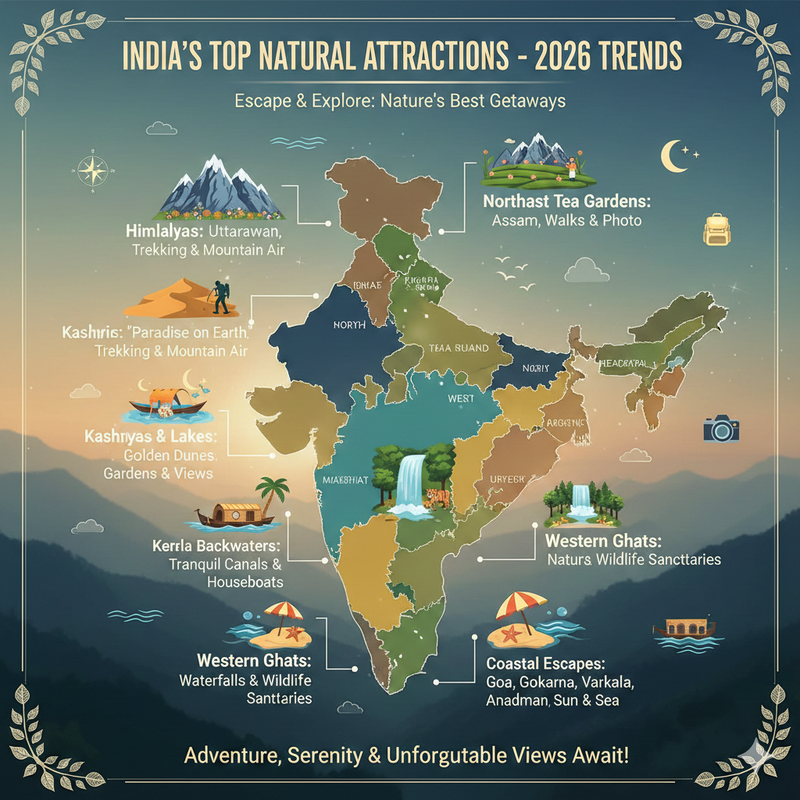
The natural beauty of India is such that it has been and will continue to be a source of attraction not only to the residents but also to the tourists all over the world. The year 2026 will see a few of the enchanting landscapes and outdoors getting the limelight for their experiences. Among these, the beautiful mountains, peaceful water bodies, and forests are the ones that surely bring the adventurists, peaceful souls, and the lovers of nature together with their stunning views.
- Himalayan Landscapes: The breathtaking ethereal heights of Uttarakhand, Himachal Pradesh, and Ladakh are always to be picked first for savouring the views, getting the best of the trekking, and the delightful mountain air.
- Backwaters of Kerala: The Kerala backwaters with their tranquil canals, verdant coconut palm forests, and luxury boat no longer feel like city life but are a serene retreat from the fast-paced urban lifestyle.
- Tea Gardens of Northeast India: The hills covered with tea gardens, especially in Assam and Meghalaya, are becoming very popular for nature walks and photography.
- Western Ghats Wildlife and Waterfalls: The Western Ghats which teem with life and are the most luxuriant of all the forests in India is the most sought after destination by nature lovers and the reason is the waterfalls which are also very huge and very picturesque.
- Beaches of Goa and Beyond: Goa is still number one but the unspoilt beaches and the crystal-clear waters of the less-known coastal areas like Gokarna, Varkala, and Andaman Islands are now more alluring than ever.
- Desert Landscapes of Rajasthan: The mesmerising golden sandy dunes of Thar Desert along with the starlit nights promise you a picturesque and dramatic experience that would tempt many in 2026.
- Valleys and Lakes of Kashmir: The lakes, gardens, and flower fields of the foothills of Himalaya continue to be a major draw for tourists to Kashmir which is nothing less than a “Paradise on Earth”.
The various natural wonders trending in India for 2026 are a clear indication of the different kinds of landscapes the country possesses making it a must-visit to the nature lovers, thrill-seekers and also the people who just want to rejuvenate with nature through the highest outdoor beauty.
How Is Luxury Travel Changing in India?
India's luxury travel is a new trend of more than just the traditional five-star hotels, which turns into trips that are more meaningful, personalized, and experience-driven. The tourists of 2026 want comfort along with culture, wellness, and notability making luxury travel the most engaging and thought-provoking of all the times.
Experience-Led Luxury
- Travelers no longer see the typical sightseeing; instead, they prefer to get the real local culture through activities, heritage, and storytelling.
Wellness as a Core Element
- Luxury travel no longer excludes yoga, meditation, Ayurveda, and nature healing; rather, they are the main activities.
Highly Personalized Itineraries
- Your travel plans can be as unique as you are with the help of custom itineraries, private services, and personalized experiences that cater to your specific preferences and travel styles.
Sustainable and Responsible Luxury
- Luxury travelers are increasingly inclined towards eco-friendly lodgings and community-based activities.
Privacy and Exclusivity
- Comfort, tranquility, and the luxury of being alone are provided by private villas, boutique hotels, and hidden places.
New Luxury Destinations
- Besides metropolitan areas, luxury travel now covers deserts, hilly areas, spirituality towns, and river trips.
Smart and Seamless Comfort
- Personalized customer service and hassle-free travel experiences are made possible by technology.
Why Do They Call It the Golden Triangle in India?
India has the Golden Triangle, a travel circuit that is very well known among tourists and connects three historical cities that together present the whole country’s rich culture, heritage, and architecture. The name indicates both the shape of the route and its importance to culture.
- Triangular Route Shape
- The cities of Delhi, Agra, and Jaipur are located in such a way that they form a triangle on the map, and this gives the name to the route as well.
- Cultural and Historical Value
- The change of cities brings the visitor to the different eras of Indian history making the whole journey very rich in culture.
- Iconic Landmarks
- The route takes in the world's most famous destinations like huge forts, palaces, and historical monuments that are also attractions.
- Blend of Past and Present
- Tourists get to see the old customs in the middle of modern city life.
- Ideal for First-Time Visitors
- The Golden Triangle is a short travel circuit that gives a complete introduction to India.
- Easy Travel Connectivity
- The three cities have excellent connectivity which makes the route not only convenient but also very popular.
What is the fee for an eVisa to India?
The application process for an electronic visa to India eVisa Fees is both simple and convenient. However, it is very useful to have an understanding of the fee structure. The price of an e-visa differs based on the type of visa, duration of stay, and nationality. The fact that payments are done online makes the procedure fast, safe, and cashless. Here is a concise pointwise guide:
- Fee structure differs with nationality: The fees are determined by the country of citizenship of the applicant.
- Differentiated by visa type: Each visa category, such as tourism, business, or medical, has different fees.
- Completed electronically: During the application process, the payment is done online.
- Guaranteed and cashless: There is no need to withdraw money or physically go to the office.
- Notification is given through electronic means: After the payment, the e-visa is emailed.
- It is mandatory at the arrival: The e-visa must be shown by the traveler at the point of entry in India.
- User-friendly system: It eliminates waiting time and makes travel arrangements easier.
What Is the Difference Between an e-Visa and a Regular Visa for India?
Foreign travelers visiting India are given two main visa options: e-Visa or regular (sticker) visa. Both visas allow foreigners to enter India, but there are certain differences with regard to the application process, the eligibility, and the usage.
Application Process
- e-Visa: Online application from anywhere around the globe, visiting embassy or consulate is not required.
- Regular Visa: Submission of documents to the Indian embassy or consulate is needed, which often involves personal visits.
Processing Time
- e-Visa: Generally, the process is faster and usually gets approved within several days.
- Regular Visa: Longer processing since it is done manually and also verification is done.
Duration and Purpose
- e-Visa: It is mainly for short-term tourism, business, or medical visits.
- Regular Visa: It can be for long-term stays, working, learning, or other purposes not covered by e-Visa.
Entry Points
- e-Visa: Only allowed at the specified airports and seaports.
- Regular Visa: Valid at all entry points that include land borders.
Document Requirements
e-Visa: Only simple online form and a digital passport copy are required.
- Regular Visa: Requires extensive documentation, photographs, and in some cases, interviews.
Why Do Foreign Travellers Visit India?
India, the land of the Gods, is a dream destination of every foreign tourist due to its unique blend of ancient heritage, multiculturalism, and nature's bounty along with many meaningful experiences. India makes every traveler’s imagination come true, from spiritual to modern city life.
Rich History and Heritage
- Tourists find it difficult to stay away from historic monuments, ancient cities, forts, and palaces that tell the story of the rise and fall of civilizations going back thousands of years.
Spiritual and Wellness Experiences
- India, the country of yoga and meditation, has also made a name for itself in the area of Ayurveda and spiritual traditions which facilitate one’s inner peace and self-management.
Cultural Diversity
- The visitor experiences the living culture of each region by tasting the local food, celebrating the festivals, and following the people’s ways, which differ in every region.
Natural Landscapes
- The foreign tourists are lured by India’s mountains, beaches, forests, rivers, and wildlife-rich areas as well as by the desert.
Affordable and Varied Travel
- A wide range of travel styles is available in India including budget-friendly and luxury ones.
Vibrant Festivals and Traditions
- All year long visitors are captivated by colorful festivals, music, dance, and local rituals.
Warm Hospitality
- The kindness of the people and the traditional hospitality are unforgettable impressions for many travelers.
Which Strategy Is Most Critical for Ensuring Sustainable Tourism in India?
Sustainable tourism development in India revolves around the conservation of nature, the maintenance of culture, and the upliftment of the local population, and at the same time allowing tourists to have so-called actual experiences. The primary approach is the promotion through the tourism of a responsible and community-oriented approach which helps to strike a balance between the impact of tourists coming and going and the conservation and development of the local populace.
- Expand on Eco-Friendly Practices – Supporting the use of renewable energy, eliminating plastic waste, and installing green infrastructure in tourist locations are some of the ways to achieve sustainability.
- Back Local Communities – Participation of local artists, guides, and businesses is necessary to ensure that tourism brings financial and social gains to the community.
- Safeguard Cultural Heritage – Limit the commercialization of historic sites, traditions, and festivals while promoting visitor-sensitive and respectful participation.
- Control Tourist Movement – Reduce the impact of tourists on the environment and culture through the usage of crowd management strategies and the imposition of limits on the number of visitors at sensitive places.
- Inform Travelers – Promote responsible conduct, wildlife safeguarding, and environmental protection as basic points of awareness among tourists.
- Stimulate Sustainable Transport – Involve public transport, cycling, and walking as main modes of transportation in tourist areas along with the use of electric vehicles.
Through the application of such diverse approaches, India will be able to guarantee that tourism will not only survive but will also be a boon for the environment and local communities, thus providing long-lasting gains for both the visitors and the residents.
How Do Foreigners Work in India?
Foreigners are allowed to work in India but they need to go through a series of legal measures in order to be in conformity with Indian laws. Only those who have the right work visa and comply with the local laws will be able to work in the country.
- Work Visa Requirement - A foreign national is supposed to have a valid employment visa for which an Indian company or organization is the sponsor.
- Eligibility - In most cases, a job offer from an Indian employer and relevant qualifications or experience is the minimum requirement.
- Visa Duration - Work visas are usually granted for the duration of the employment contract with an option to renew.
- Registration with Authorities - Some foreigners are required to report to the Foreigners Regional Registration Office (FRRO) within a certain period after they arrive.
- Tax Compliance - Foreign workers are obliged to follow the Indian income tax regulations and those who live in the areas where the regulations apply are expected to pay their taxes accordingly.
- Prohibited Work - Some industries and freelance work might be completely banned unless the specific approval is granted under visa terms.
To sum up, the foreigners can come to India legally for work with the right visa, the support of the employer and compliance with the local regulations on employment and taxes.
How Do Tourists Pay for Things in India?
The various payment methods available for tourists in India not only open up the option of cashless and easy transactions but also compatibility among cities, towns, and tourist spots.
The most common payment methods used by the tourists are:
- Cash: The Indian Rupees (INR) continue to be the king in the markets, street vendors, and rural places. It is a good idea to always have small notes for daily use.
- Credit and Debit Cards: The three big ones, Visa, MasterCard, and RuPay, have carved out a good percentage of acceptance in hotels, restaurants, shopping malls, and larger retail outlets. Credit and debit cards, however, are not accepted in some distant localities.
- Mobile Payments: Digital wallets and UPI apps are on every smartphone and so they are the most sought-after cashless payment ways via QR codes. The tourist can access platforms like Google Pay or Paytm in the cities.
- ATMs: The presence of ATMs in all major cities and towns makes it easy and dependable to get cash in the local currency. A few international cards can be accommodated at the ATMs operated by the bigger bank branches.
Even though digital payments are on the rise, it is still prudent for those visiting to have some cash on them for small purchases or in those areas where card payments are less likely to be accepted.
Can Foreigners Use the Go Taxi App in India?
Foreign tourists can indeed utilize the Go Taxi application in India, which also happens to be the most comfortable mode of transport for visitors in the cities. The Go Taxi app (often referred to as GoSmart in some regions or under other similar names) operates like other ride-hailing services, granting access to booking rides quickly, safely, and without any communication barriers for the tourists.
- Foreigners traveling to India can obtain the application on their mobile phones, use their phone numbers to register, and get the ride done almost immediately. The app provides choices for different vehicle categories like economy, premium, or bigger cars for groups thus making it suitable for any travel plan.
- The Go Taxi app is very common in most of the big cities of India and it works pretty well together with other ride-hailing services that are also quite popular. It gives estimated fares, ride tracking, the driver's phone number, and secure digital payments which are making it very easy and safe for foreign visitors to move around in the city.
To sum up, the Go Taxi app is a very practical and tourist-friendly means for foreigners to discover the cities, get to the attractions or move around without the stress of dealing with local drivers or finding transportation right away.
Can Foreigners Buy SIM Cards in India?
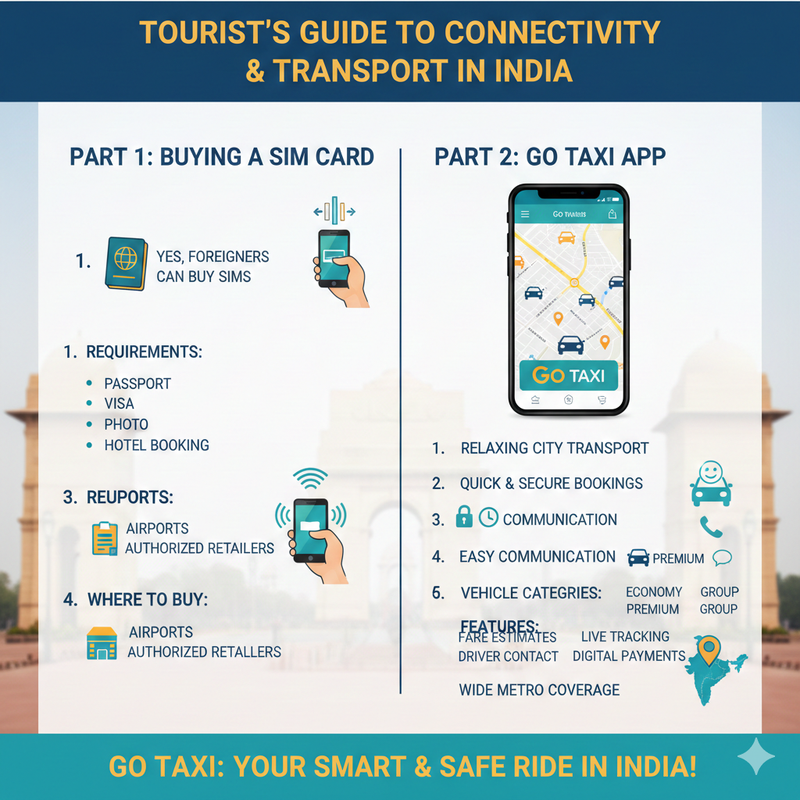
Tourists from abroad are allowed to use the Go Taxi app in India which is also the most relaxing transport for the tourists in the cities.
- The Go Taxi mobile app (sometimes people call it GoSmart in certain places or by other similar names) is operating like the aforementioned ride-hailing services giving access to booking rides very quickly and securely and also allowing the tourists to communicate without any barriers.
- Foreigners who wish to travel to India can download the app on their phones, register with their phone numbers and get the ride almost instantly. The app offers different vehicle categories such as economy, premium, or a bigger car for a group making it suitable for any travel plan thereby reducing the travel hassle.
- The Go Taxi app is very much in use in most of the metropolitan areas of India and it can be easily integrated with other cab services which are also very popular. It offers fare estimates, ride tracking, the driver’s phone number, and safe digital payments that are all making it very easy and safe for the foreign tourists to get around the city.
- In conclusion, the Go Taxi application is a highly efficient and tourist-friendly method for the foreigner to explore the cities, visit the sights or move around without the issue of dealing with the local drivers or finding transportation immediately.
What Do Tourists Eat in India?
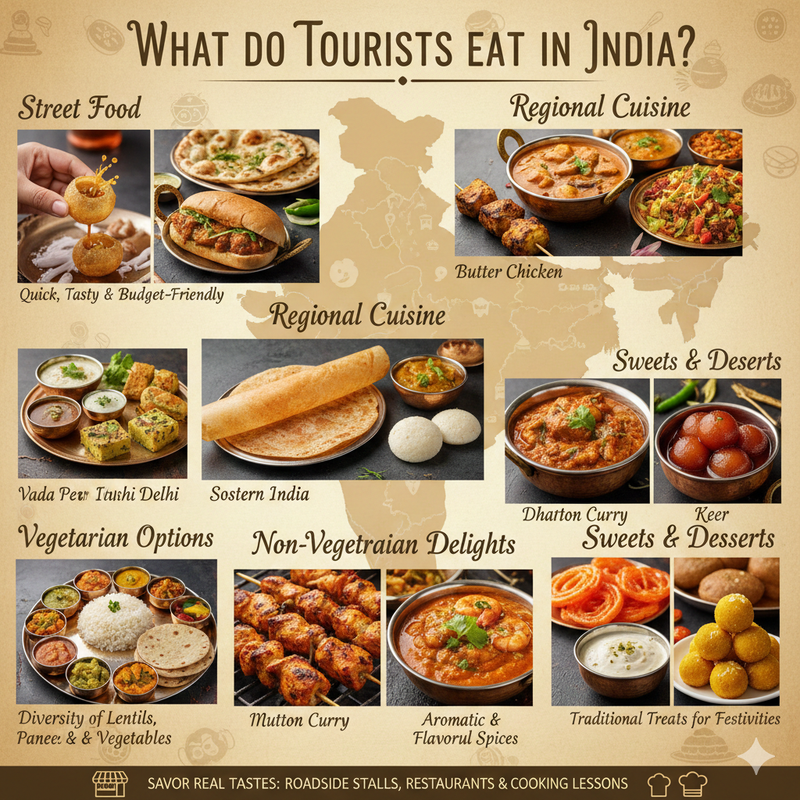
India is a dreamland for the gourmets, presenting an extremely wide range of food that changes with every region, culture, and climate. The tourists are part of the whole experience, tasting local and then letting themselves be carried away by the unforgettable and special flavors.
Some of the popular food types for tourists in India are the following:
- Street Food: The different parts of the country have their own specialties such as chaats in Delhi, vada pav in Mumbai, and pani puri all over the country. Besides, street food provides a local culinary experience that is quick, tasty, and friendly to one’s pocket.
- Regional Cuisine: In the culinary aspect, each Indian state is a world of its own. Northern India is famous for its rich gravies, tandoori preparations, and various kinds of bread like naan and paratha. In contrast, Southern India offers dishes made of rice and fermented batter (dosa, idli, and sambar) along with coconut-based curries. Eastern India is a combination of fish and sweets like rasgulla, while Western India is all about spicy snacks, dhokla, and coastal seafood.
- Vegetarian Options: The diversity of vegetarian recipes is a result of the cultural and religious influences in India. The tourists will have the opportunity to relish lentils, paneer, vegetables, rice, and flatbreads, which will be prepared in many different ways.
- Non-Vegetarian Delights: The most popular meat dishes are chicken tikka, mutton curry, and seafood which are usually made with the aromatic and flavorful spices and herbs.
- Sweets and Desserts: The visitors usually get to taste the traditional sweets like gulab jamun, jalebi, kheer, laddoo, etc. which are generally offered during festivities and also in some special occasions.
The travelers in India can savor the real tastes of the local food at the roadside stalls, the restaurants, and even at the cooking lessons, thus making gastronomy an integral part of the journey.
Final Thoughts
Yes, indeed. In 2026, India is a place of contradictions and harmony, a mix of the old and the new, a place of tranquility and activity at the same time. If you want to experience spirituality, adventure, culture, nature, or relaxation, India is the right place as it will provide you with experiences that are hard to forget and will last beyond the end of your journey. Make your plans thoughtfully, travel with patience, and let India astonish you at every turn.
Comments