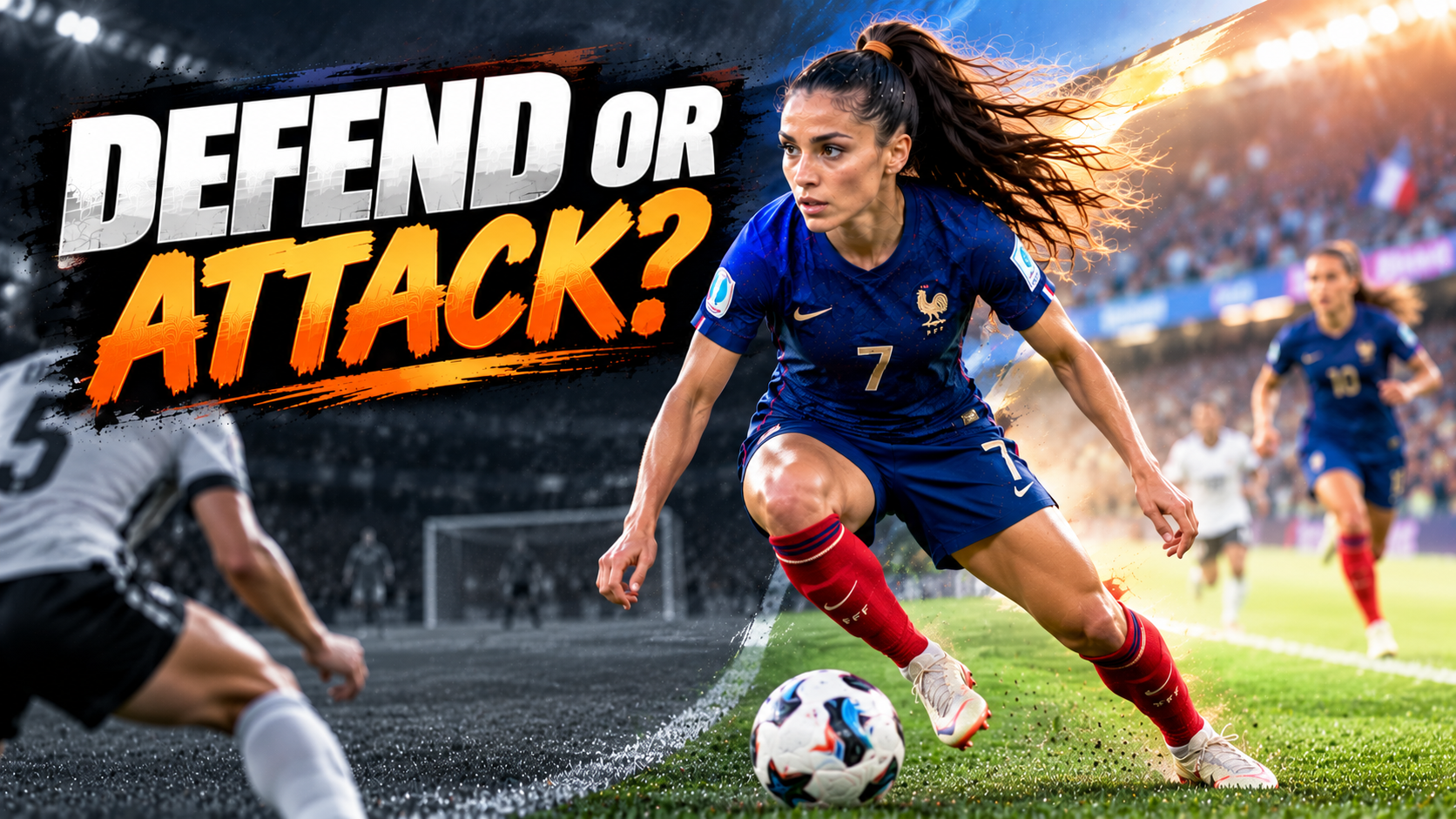
Sakina Karchaoui adapts between defensive and attacking roles by combining positional awareness, quick decision-making, ball control and intelligent movement. As a left-back who can also operate in midfield, she must recognise when to protect her team's defensive shape and when to move forward to support an attack. This balance is important in modern women's football, where defenders are expected to contribute to both phases of play.
Karchaoui has played for Montpellier HSC, Olympique Lyonnais and Paris Saint-Germain while representing the France national team. These experiences have placed her in different tactical environments and required her to understand how her responsibilities change according to the team's formation and match situation. Her versatility illustrates why modern defenders need more than tackling ability to perform effectively at the highest level.
How Does Karchaoui Handle Her Defensive Responsibilities?
When her team does not have possession, Karchaoui's primary responsibilities include protecting the left side, tracking opposing attackers and helping maintain the defensive line. She must remain aware of the winger in front of her, the movement of opposing midfielders and the space behind her position.
One-on-one defending requires patience and control. Instead of immediately attempting a tackle, a defender may need to delay the attacker, restrict the available space and wait for support from a teammate. Quick footwork and acceleration can help Karchaoui respond when an opponent changes direction or attempts to move into open space.
Positioning is equally important. If she moves too far forward while the opposition has an opportunity to counterattack, space may open behind her. By recognising the danger early, she can adjust her position and help the team remain organised.
Her defensive role is therefore not limited to winning the ball. It also involves reducing the opposition's options and helping the team maintain its shape.
How Does She Recognise Opportunities to Attack?
A modern full-back must know when moving forward will benefit the team. Advancing at the right moment can create an extra passing option, stretch the opposition's defensive line and help move possession into attacking areas.
Karchaoui can use the left flank to support a winger, provide width or offer a passing option to a midfielder. Her movement can force an opposing defender to choose between tracking her run and remaining close to another attacker.
The decision to advance depends on several factors, including the location of the ball, the position of teammates and the number of opponents ready to counterattack. When her team has secure possession and sufficient cover, a forward run may create an attacking advantage.
However, attacking movement must be coordinated. If the winger and full-back occupy the same space, they may make the attack easier to defend. Effective movement involves recognising where teammates are positioned and choosing a route that gives the team an additional option.
How Does Ball Control Help Her Switch Between Roles?
Ball control is important because a player often needs to move quickly from receiving possession to making a decision. A poor first touch can invite pressure, while a controlled touch can create time to pass, carry the ball forward or change direction.
Karchaoui's technical ability allows her to participate in possession-based attacks. From the left side, she can help move the ball out of defensive areas, connect with midfielders and support progression towards the opposition's penalty area.
When opponents press aggressively, she may need to use short passes to retain possession. When space opens ahead, carrying the ball forward can help her team gain territory. The appropriate decision depends on the pressure around her and the availability of passing options.
These skills connect her defensive and attacking responsibilities. A defender who can retain possession under pressure gives the team another way to progress the ball, rather than relying exclusively on long passes or clearances.
What Role Does Tactical Awareness Play in Her Versatility?
Tactical awareness helps a player understand when to advance, when to hold position and how to respond to changes in possession. Without it, even a technically gifted defender can leave dangerous spaces for the opposition.
Karchaoui's role requires her to recognise the team's shape and coordinate her movement with centre-backs, midfielders and wide attackers. If a teammate moves forward, she may need to provide cover. If the team builds an attack down the opposite flank, she must judge whether to stay in a defensive position or move into a supporting role.
These decisions are influenced by the coach's system. Some formations encourage full-backs to advance high and wide, while others ask them to move into central areas during build-up play. A player's responsibilities can therefore change from one match to another.
For young footballers, this highlights the importance of learning the tactical purpose behind a movement instead of simply copying a player's position on the pitch.
How Does Karchaoui Support Attacks Without Leaving France Exposed?
Attacking full-backs can create valuable opportunities, but their forward movement can also expose space behind them. Opponents may try to exploit that space immediately after winning possession.
To manage this risk, teams use coordinated defensive cover. A midfielder may move towards the left side, a centre-back may adjust position, or the team may retain enough players behind the ball to respond to a counterattack.
Karchaoui must consider these relationships when deciding whether to advance. If teammates are well positioned and possession is secure, she may have more freedom to support the attack. If the opposition is ready to break forward, maintaining her defensive position may be the better option.
This balance is particularly important against technically strong opponents, who can quickly turn a turnover into a dangerous attack. Effective full-back play involves understanding not only the potential reward of an attacking run but also the defensive consequences.
How Does Playing in Different Positions Benefit Her Game?
Karchaoui is widely known as a left-back, but she has also been used in midfield. Experience in different roles can help a player understand the game from multiple perspectives.
A midfielder must often receive the ball under pressure, scan for passing options and connect defensive and attacking phases. A full-back must balance these responsibilities with protecting wide areas and tracking opposing forwards. Experience across both roles can help a player understand where teammates need support and how space develops during an attack.
Versatility can also provide tactical options for a coach. Depending on the match, a player may be asked to defend more conservatively, advance frequently or move into midfield when the team has possession.
However, versatility does not remove the need for positional discipline. Players must still understand their immediate responsibilities and follow the team's tactical plan.
Conclusion
Sakina Karchaoui adapts between defensive and attacking roles through technical ability, tactical awareness, positional discipline and intelligent movement. She must protect the left side when her team is defending while recognising opportunities to support possession, advance into space and help create attacking options.
Her versatility demonstrates the demands placed on modern full-backs, who are expected to contribute throughout the match without compromising the team's defensive structure. For readers following leading Women's soccer players, Karchaoui's career provides a useful example of how adaptability and decision-making can help a player contribute in multiple phases of football.
Frequently Asked Questions
1. How does Sakina Karchaoui balance attacking and defending?
She balances both responsibilities by assessing the match situation, maintaining defensive awareness and advancing when the team's positioning allows her to support an attack.
2. What position does Sakina Karchaoui usually play?
She is widely recognised as a left-back, although she can also operate in midfield depending on the tactical system.
3. Why is tactical awareness important for Karchaoui?
It helps her judge when to move forward, when to remain in position and how to coordinate with teammates during changes in possession.
4. How does her technical ability help France and PSG?
Her ball control, passing and ability to carry possession help her teams progress the ball and create additional options in attacking areas.
5. What can young players learn from Karchaoui's versatility?
Young players can learn to combine defensive discipline with attacking awareness, make decisions based on the match situation and understand the responsibilities of different positions.
Comments